Posts

SVN checkout without branches and tags

Subversion (SVN) is a decent step up from CVS, and Maven (MVN) likewise from Ant. However one thing continues to bug me about how the two work together. Since MVN requires a fixed directory layout of /trunk, /tags and /branches, it becomes more and more painful to checkout or update a complete corporate source tree from one of the lower roots. In the perfect world, every project may be checked in at the root of the tree, but we all know the world ain't perfect and it's not unusual to require checkout and build of up to a dozen SNAPSHOT dependencies spread around deeper in the hierarchy. There is no (to my knowledge) easy way around this, either you have to live with insanely long checkout times and the associated waste of disk space, or meticulously checkout each every project trunk individually. As unimpressed I am by the Java language itself, the hat must come off to the plethora of readily available libraries on this platform. One of these libraries is SVNKit , a complete cl...
My issues with Spring

Image
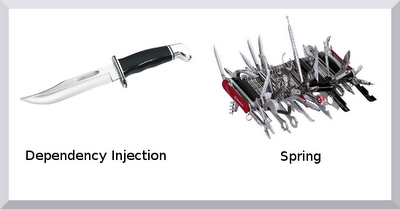
One of the things I've had to come to turns with as a professional Java developer, is navigating the massive chaos of frameworks out there. It doesn't really matter which corner of the development stack we're talking, in Java we're sure there won't ever be just one official standard; if we're lucky, we can identify a state-of-the-art de-facto standard and if we're *truly* lucky, our choice will remain a good one for longer than a few years. One of those de-facto standards appears to be Spring . There is little doubt, that IoC ( Inversion of Control ), or more specifically DI ( Dependency Injection ), can be a great tool to decouple concrete dependency layers. However, in my opinion Spring introduces just as many problems as it solves, and here's my take on why. Everything and a Kitchen Sink While Spring does address IoC/DI, it also does a gazillion other things as well - as evident by looking at the Spring maven repo . On one of the project I was on, my ...

Android and task killers: Don't

Image
There's an awful lot of misconceptions regarding Android and multitasking out there. When you read help forums and the issue of performance tweaking comes up, a very popular answer is to use a task killer to close unwanted apps. Even venerable tech people like TWiT's Leo Laporte appears to have acquired this habit. I reckon that these people have no idea how Android actually works and/or are making erroneous assumptions pulled over from the world of traditional desktop computing. In the best case, nothing happens when you kill an application except you spend time manually doing something that would otherwise have been done for you automatically at a later time. Worst case, you crash an application or get up too late tomorrow because your alarm didn't go off. How Android does things At an architectural level, applications running on Android are actually not supposed to halt its process in the traditional sense as we are used to from most desktop operating systems. When yo...

Android cubicle figure

Image
So my girlfriend, who is very artistic, has been doing some special clay modeling lately. Since I'm the kind of guy who likes to have lots of geek cubicle stuff (even if I do not work in a cubicle), what better to ask for than an Android figure. And lo and behold, this time I got what I asked for... hope this is a good indicator for the new year. Cute eh?

Fun with the iGala picture frame

Image
NOTE: This is an old article that I never got around to finishing. So it might or might not still be relevant. Turns out iGala is about to launch Android support for the frame, but until then, I suspect the following could still be of interest to some. One of the most geeky of shopping sites must be thinkgeek.com. They have many wonderful and useless items to appeal to the geek inside of you, hell even my wife had a blast reading their catalog. Anyway, one of the items they sell (exclusively apparently) is the iGala digital picture frame, from Aequitas Technologies. Now I've come across countless of these, but the iGala is one of the few ones running an easy-to-access embedded Linux. In the following I will show what I mean and provide some documentation that I have collected. Probing the frame from outside It's an 8" LCD, capable of a 800x600 resolution and with a resistive touch membrane in front. Apart from that, not much info is given to the consumer - in spite...

Android debug bridge on ubuntu 9.10

It turns out the latest Ubuntu release makes it a bit more difficult to connect the multi purpose Android debug bridge to your Android device. The following is really just an update of my older entry , to remind myself of the changes in Ubuntu 9.10. This stuff is pieced together from various other sources online (mostly android-discuss ) and thus not particularly original. Ok so first of all, there are quite a few more vendors and devices now (yay). In order to identify your device, make sure your device is not connected and then execute the Linux command lsusb. casper@workstation:~$ lsusb Bus 002 Device 001: ID 1d6b:0001 Linux Foundation 1.1 root hub Bus 005 Device 001: ID 1d6b:0001 Linux Foundation 1.1 root hub Bus 001 Device 004: ID 07cc:0501 Carry Computer Eng., Co., Ltd Mass Storage Bus 001 Device 002: ID 0409:005a NEC Corp. HighSpeed Hub Bus 001 Device 001: ID 1d6b:0002 Linux Foundation 2.0 root hub Bus 003 Device 002: ID 051d:0002 American Power Conversion Uninterruptible Power ...

Tweaking javac leniency

While a great fan of type-safety and static checking, I also like a certain amount of leniency from compilers. Sun's Java compiler is a good example of one that goes overboard in some anal, misunderstood attempt at servicing the developer. In the following I will explain why I think so and how to fix it by modifying the publicly available source code for the compiler. Note that although I have done something similar before, I am no compiler expert and never will be. The modifications shown in this post are mere tweaks and I will stay far away from anything below semantic analysis. "Exception is never thrown" Have you ever had a good coding session, with design, implementation and refactoring happening at an immense speed as you try to perfect the internals of a piece of code? All of a sudden you are distracted because a try block no longer contains any methods that declares a checked exception. So now, in order to satisfy the compiler, you'll have to focus on removin...